
A slow sink and a basement floor-drain backup may originate in very different parts of your plumbing system. Knowing which fixtures are affected—and what happens when you use water elsewhere—can help you explain the problem and get the right first response.
Drain cleaning usually addresses a clog affecting one fixture or one area of the home. Sewer line cleaning addresses a blockage in the larger pipe that carries wastewater away from the building. Multiple affected fixtures, cross-fixture backups, or basement floor-drain problems may point deeper in the system, but a professional evaluation is needed to confirm the location.
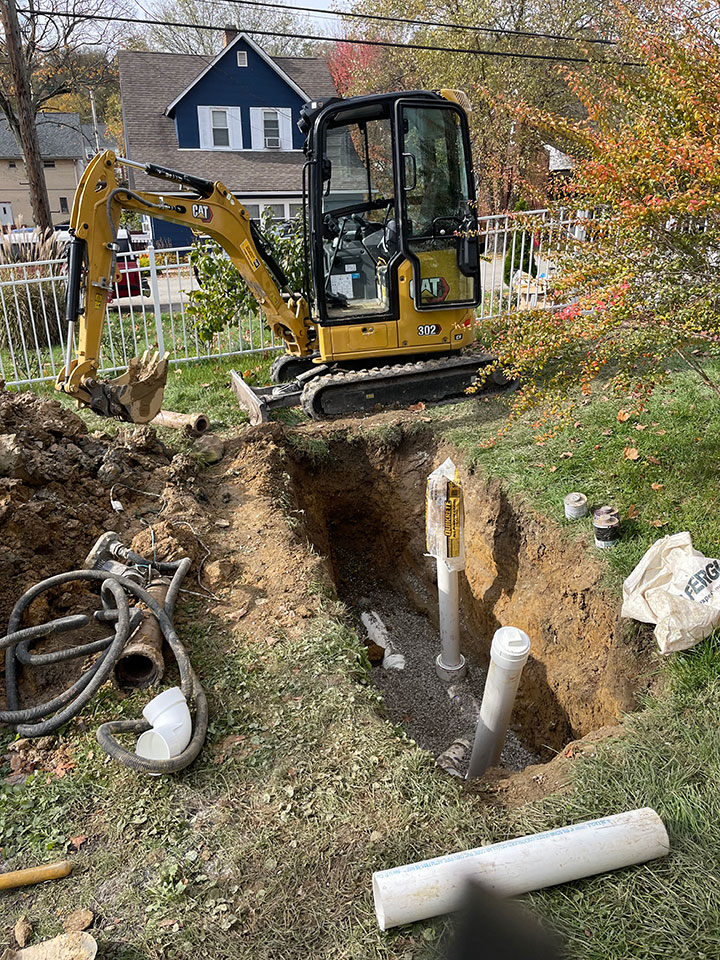
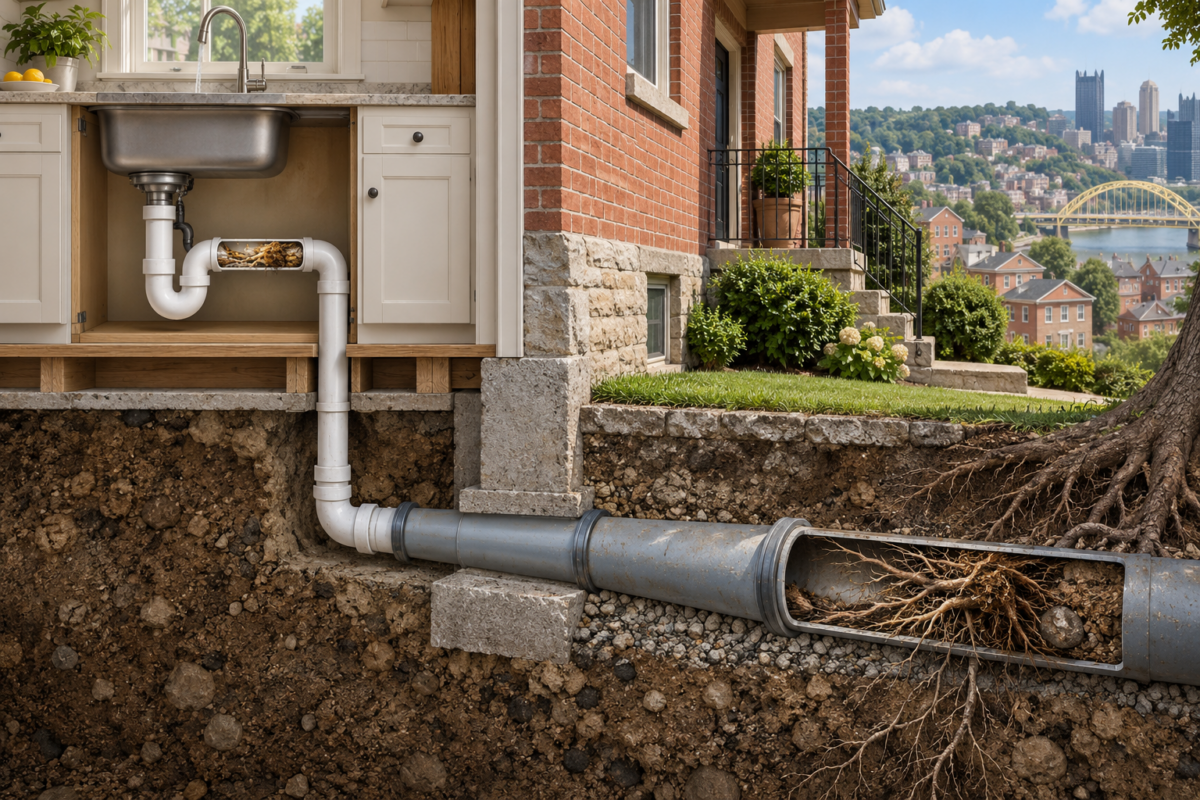
Inside a home, individual fixture drains connect to branch lines. Those branches eventually feed into the home’s main sewer line. In Pittsburgh, the privately owned connection running from a building’s internal plumbing to the public sewer main is called the sewer lateral. Pittsburgh Water explains that property owners are responsible for the lateral, while the utility maintains the public sewer main and a small portion of the connection known as the wye.
Symptoms provide clues about where a restriction may be, but they do not prove the cause or exact location.
| Comparison | Drain or branch-line clog | Main sewer line or private lateral blockage |
|---|---|---|
| Affected area | Usually one fixture or one nearby group | Often several fixtures or much of the home |
| Typical symptoms | One slow or stopped sink, shower, tub, toilet, laundry drain, or floor drain | Multiple drains slow at once, gurgling, repeated backups, or water rising in another fixture |
| Likely access point | Fixture opening, trap, or nearby branch access | Main cleanout or another approved sewer access point |
| Common professional response | Inspect the local drain and clear the obstruction, often with an auger | Evaluate the main line, clear the blockage with appropriate equipment, and consider camera inspection |
Professional drain cleaning focuses on a localized obstruction, such as a bathroom sink slowed by hair and soap residue, a kitchen drain restricted by food debris or grease, or a blocked toilet.
The strongest clue is limited impact: one fixture—or two fixtures sharing a branch—has trouble while the rest of the house drains normally.
A technician may inspect an accessible trap or use an auger to remove the obstruction. The approach depends on the fixture, pipe, and material involved. Sewer Flow LLC provides professional drain cleaning and residential plumbing service for localized issues.
Main sewer line cleaning targets the larger pipe that receives wastewater from branch drains and carries it toward the public sewer. A restriction there can affect multiple parts of the home.
Potential causes include grease and solids, wipes, foreign material, tree roots, and scale. Older piping may also have rough surfaces or defects that collect debris.
Cleaning can restore flow, but it cannot repair a cracked, offset, bellied, or collapsed pipe. If a blockage returns or damage is suspected, further diagnosis may be appropriate after the line is clear enough to inspect. Sewer Flow LLC offers main sewer line cleaning and routine sewer maintenance.
The affected fixtures and the way they interact are more informative than the word “clog.” Watch for these patterns:
These are signs, not a definitive diagnosis. Plumbing layouts differ, and two homes with similar symptoms can have different causes.
A technician begins by narrowing down the affected area. Expect questions such as:
The technician may observe drainage and check accessible traps, cleanouts, or branch connections. Standing wastewater or a heavy obstruction may need to be cleared before camera work.
For recurrent, widespread, or potentially structural problems, a camera may identify roots, scale, separated joints, cracks, or other conditions. Sewer Flow LLC’s guide to what a sewer camera inspection can reveal explains when that step adds value.
These services are related, but they are not interchangeable:
Snaking or augering uses a cable and suitable head to open or remove certain obstructions. It often works for a localized clog or restores a path through a blocked line.
Hydro jetting uses controlled, high-pressure water to break up material and clean pipe walls. It can address grease, sludge, roots, and recurring deposits when the pipe’s condition makes jetting appropriate. It is not right for every pipe, particularly when damage is suspected. Learn more about hydro jetting and drain cleaning.
Sewer camera inspection is diagnostic; it does not remove a clog or repair damage. Blockages or standing wastewater may limit visibility, so cleaning sometimes comes first.
Describe the drainage pattern so the technician can match the equipment to the problem.
Pittsburgh property owners are responsible for the private sewer lateral extending from internal plumbing to the public main. Pittsburgh Water is responsible for the public main and wye connection.
If nearby homes are also backing up—or trouble appears only during heavy rain—the public system may need assessment. Pittsburgh Water advises residents with sewage pooling indoors to contact its emergency dispatch and report the location, recurrence, connection to indoor water use, and rain timing. Avoid contact with sewage while awaiting help.
You do not need to diagnose the pipe. Tell the team:
This helps the technician prepare for a local clog, possible main-line blockage, or further testing.
When choosing between drain cleaning vs. sewer line cleaning, start with what the plumbing is doing. One affected fixture often points toward local drain cleaning; several fixtures, cross-fixture backups, or floor-drain trouble justify evaluating the main line.
For drain cleaning in Pittsburgh, sewer line cleaning, or help locating a backup, call Sewer Flow LLC at (412) 515-FLOW or use the online contact form. The team can recommend an appropriate response after evaluating the system.
It can be either. One affected toilet may indicate a local obstruction. If flushing raises water in a tub or floor drain—or several fixtures are slow—the restriction may be farther downstream. A technician can confirm the location.
No. A camera cannot see through murky standing water or solid material. Flow may need to be restored before it can provide a useful view.
No. Hydro jetting removes obstructions and buildup from suitable pipes. It does not seal cracks, realign joints, correct a belly, or rebuild a collapsed section.
The fixtures may share a drain path. A downstream restriction can force flushed water toward the lower tub opening. Limit water use and arrange an evaluation, especially if other fixtures are affected.
Yes. Pittsburgh Water says property owners are responsible for the private sewer lateral, while it maintains the public main and wye. If the location is uncertain or neighbors are affected, contact Pittsburgh Water.