
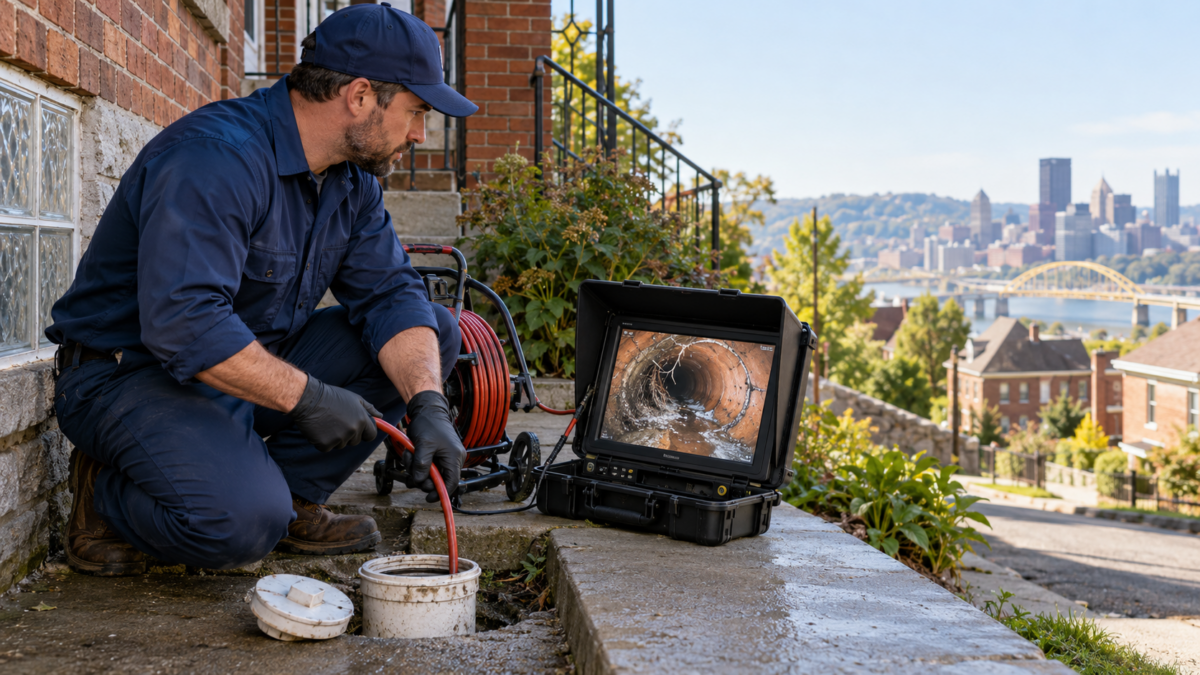
Recurring sewer backups, slow drains, and gurgling toilets can have several possible causes. Without seeing inside the sewer line, it may be difficult to know whether the problem is a routine blockage, a damaged pipe, root intrusion, or a combination of issues.
With a sewer camera inspection, a technician can examine the interior of the sewer lateral rather than relying on guesswork. In Pittsburgh, camera footage may reveal older terracotta pipe, cast-iron corrosion, newer PVC repair sections, root intrusion, offset joints, standing water, buildup, house-trap restrictions, sharp turns, or steep drops near the municipal sewer main.
At Sewer Flow LLC, the purpose of an inspection is not simply to locate a clog. It is to understand the condition of the sewer path and determine which solution is appropriate. Depending on the findings, that may involve hydro jetting, sewer maintenance, trenchless sewer repair, targeted excavation, or sewer line replacement.
If you are dealing with recurring sewer backups or need to understand the condition of your line, schedule a sewer camera inspection with Sewer Flow LLC.
What Is a Sewer Camera Inspection?
A sewer camera inspection utilizes a waterproof video camera attached to a flexible cable or push rod. A technician inserts the camera through a cleanout, house trap access point, floor drain, or another suitable opening.
As the camera travels through the pipe, the technician can view its interior condition in real time.
A sewer line camera inspection may identify:
- Pipe material
- Tree roots
- Grease, sludge, scale, or sediment
- Cracks and breaks
- Offset joints
- Separated pipe sections
- Bellies or low spots
- Standing water
- Collapsed areas
- Improper material transitions
- Sharp bends
- Blockage locations
- Approximate depth and direction when locating equipment is used
The footage provides a clearer basis for recommending service. It can also explain why a sewer problem keeps returning after the line has been snaked or temporarily cleared.
Why Sewer Camera Inspections Matter in Pittsburgh
Many Pittsburgh homes have older sewer laterals and multiple generations of plumbing repairs. A single line may contain cast iron near the basement, terracotta through the yard, and PVC where a previous repair was completed.
Each material behaves differently. The transition points between them may also become problem areas where debris collects, roots enter, or pipe sections shift.
Pittsburgh’s hillsides, mature trees, older housing stock, and deep sewer connections can complicate diagnosis. A camera inspection helps separate a basic blockage from a structural sewer problem.
Without a video inspection, a homeowner may pay for repeated drain cleaning without addressing the underlying cause of the clog.
For Sewer Flow LLC, camera footage is the starting point for a practical repair plan. It helps explain what is happening, where it is happening, and whether cleaning, trenchless repair, excavation, or another service makes sense.
From the House to the House Trap and Sewer Main
Wastewater from toilets, sinks, tubs, showers, laundry drains, and floor drains flows into the building drain. It then travels toward the house trap, if one is present, and continues through the private sewer lateral to the public sewer main.
From the House Plumbing to the House Trap
A house trap is a plumbing trap installed along the building drain or sewer line. It is more common in older plumbing systems and may be located in the basement or near the foundation.
Problems in this portion of the line may include:
- Cast iron corrosion
- Scale and sludge buildup
- Grease accumulation
- Restricted flow through an older trap
- Broken cleanout caps
- Improper fittings
- Root intrusion near the foundation
- Standing water around the trap
A house trap can also limit camera access. In some homes, separate access points may be needed to inspect both sides.
From the House Trap to the Sewer Main
After the house trap, the sewer lateral continues underground toward the public sewer main. It may run beneath a yard, driveway, sidewalk, or street-side area.
The camera may reveal:
- Terracotta or clay pipe
- Roots entering through joints
- Cracks or crushed sections
- Offset joints
- Bellies and standing water
- PVC repairs connected to older pipe
- Steep grades or long drops
- Deep sections
- Separation near the main connection
The private sewer lateral is generally the property owner’s responsibility from the building plumbing to the public sewer main.
Common Problems Found During a Pittsburgh Sewer Camera Inspection
Root Intrusion
Roots often enter through small openings in terracotta joints, cracked pipes, separated sections, or damaged transitions.
The camera may show fine roots, thick root growth, or a large mass restricting the pipe.
Possible solutions include:
- Mechanical clearing
- Hydro jetting when appropriate
- Routine maintenance if the pipe remains sound
- Trenchless lining if roots are entering through repairable defects
- Excavation if the pipe is collapsed or severely separated
Hydro jetting can clear roots and debris, but it does not repair the opening that allowed the roots to enter. Repeated root growth usually requires structural correction.
Terracotta or Clay Pipe Damage
Terracotta and clay pipes are common in older Pittsburgh sewer laterals. They can remain functional for many years, but their joints and pipe sections may crack, shift, separate, or allow roots to enter.
Camera footage may show:
- Root-filled joints
- Cracked pipe walls
- Missing pipe sections
- Offset joints
- Soil visible through openings
- Standing water
- Separated pipe
If the line remains structurally intact, cleaning or hydro jetting may restore flow. Trenchless sewer lining may also be possible if the pipe retains enough shape and continuity.
Collapsed or heavily offset pipe may require excavation or replacement.
Cast Iron Scaling and Corrosion
Cast iron is often found near foundations, below basement floors, or within older building drains.
Over time, rust and mineral scale can narrow the pipe’s interior and trap waste.
The camera may show:
- A rough interior surface
- Rust scale
- Reduced pipe diameter
- Flaking pipe walls
- Debris collecting due to corrosion
- Poor connections to clay or PVC
Depending on the condition, Sewer Flow LLC may recommend descaling, hydro jetting, lining, or replacement.
Not every old cast-iron line should be aggressively jetted. The inspection helps determine whether the pipe can safely handle cleaning.
PVC Sewer Line Problems
PVC is smoother and newer than clay or cast iron, but installation problems can still affect performance.
The camera may reveal:
- Improper slope
- Bellies
- Standing water
- Misaligned fittings
- Poor transitions
- Crushed sections
- Sharp bends
Cleaning may solve a blockage in an otherwise sound PVC line. Problems involving slope, alignment, or damaged fittings may require targeted excavation.
Mixed Pipe Materials
Many Pittsburgh sewer laterals contain more than one pipe material.
A home may have cast iron near the foundation, terracotta through the yard, and PVC where a previous repair was completed.
Transition points may show:
- Poor alignment
- Diameter changes
- Root intrusion
- Separated fittings
- Debris is collecting at the connection
An experienced sewer technician evaluates more than the material itself. The technician also considers how the materials are connected and whether the transition is causing the problem.
Pipe Bellies and Standing Water
A sewer belly is a low area where water collects in the pipe rather than flowing toward the main.
Possible causes include:
- Soil settlement
- Poor installation
- Ground movement
- Inadequate pipe support
- Movement at nearby joints
Hydro jetting may clear debris from a belly, but it cannot correct the pipe’s slope. Excavation is often needed when the low area repeatedly causes backups.
Offset Joints and Separated Pipe
An offset occurs when two pipe sections no longer line up. A separation occurs when connected sections pull apart.
These defects may catch waste, allow roots to enter, or permit soil to enter the pipe.
Cleaning can remove the immediate blockage but cannot realign the pipe. Trenchless repair may be possible in some cases. Severe offsets usually require targeted excavation.
Sharp Angles and Difficult Turns
Tight bends and improper fittings can slow wastewater flow, catch solids, and prevent inspection or cleaning equipment from passing.
The camera may show repeated buildup at one bend or may be unable to travel beyond the fitting.
Cleaning may help if the line is otherwise sound. Repeated problems may require better access, fitting replacement, or reconfiguration of the affected section.
Long Drops Before the Sewer Main
Some Pittsburgh properties have steep sewer sections or long drops before the lateral reaches the municipal main.
These layouts can make inspection, locating, cleaning, and repair planning more difficult.
The camera may show:
- A steep transition
- Debris collecting near the drop
- Separation near the bottom
- A difficult main connection
- A section where the camera cannot safely pass
Additional access points or locating equipment may be needed. The repair could involve hydro-jetting, trenchless methods, excavation, or a combination of these services.
Heavy Sludge, Grease, or Debris
Not every sewer problem involves a broken pipe. Some lines are structurally intact but restricted by grease, sludge, wipes, sediment, or scale.
Possible solutions include:
- Drain cleaning
- Hydro jetting
- Descaling
- Scheduled sewer maintenance
- Guidance on what should not be flushed or drained
A second camera pass after cleaning may provide a clearer view of the pipe wall.
How Sewer Flow LLC Determines the Right Fix
A camera inspection should not automatically lead to the most expensive repair.
The correct solution depends on:
- Pipe material
- Severity of damage
- Location and depth
- Access
- Pipe slope
- Condition of nearby sections
- Whether the problem is a blockage, a structural defect, or both
When Hydro Jetting May Be Enough
Hydro jetting is a technique that uses high-pressure water to clean the interior of a sewer line.
It may be appropriate when:
- The pipe is structurally intact
- The problem involves grease, sludge, roots, scale, or debris
- The camera shows buildup rather than collapse
- Soft blockages keep returning
- The line needs cleaning before lining or further inspection
Hydro jetting can clean more of the pipe wall than basic snaking. However, it does not rebuild cracked, collapsed, offset, or separated pipes.
When Trenchless Sewer Repair May Be Possible
Trenchless sewer repair may rehabilitate damaged pipe without digging a full open trench.
It may be considered when:
- The pipe is cracked but retains its shape
- Roots are entering through joints
- The line can be cleaned and prepared
- The alignment is suitable
- The homeowner wants to reduce surface disruption
Trenchless repair does not work for every sewer line. Collapse, missing pipe, severe offsets, or poor slope may require excavation.
When Excavation Is Needed
Traditional sewer repair may be necessary when:
- The pipe has collapsed
- A severe offset prevents lining
- The slope must be corrected
- A belly repeatedly causes backups
- A sharp angle needs reconfiguration
- A house trap or transition is damaged
- The pipe has lost too much structure
Sometimes excavation is the most practical and durable option.
When a Hybrid Repair Plan Makes Sense
Some sewer laterals require more than one approach.
A repair plan could include:
- Hydro jetting to clean the line
- A second camera inspection
- Trenchless lining for a cracked section
- Spot excavation for a collapse or severe offset
- Replacement of a house trap or poor transition
The camera footage tells the story. Sewer Flow LLC can explain the findings and recommend a solution based on the line’s actual condition.
Signs You Should Schedule a Sewer Camera Inspection
Consider scheduling a sewer scope if you notice:
- Repeated sewer backups
- Basement floor drain backups
- Several slow drains at once
- Gurgling toilets
- Sewer odors
- Water rises in one drain when another fixture is used
- Backups after laundry or showering
- Recurring need for snaking
- Large trees near the sewer path
- A previous repair estimate without video evidence
A sewer camera inspection can also be useful when buying or selling an older Pittsburgh home.
What to Expect During the Inspection
The process generally includes:
- Identifying the best access point
- Inserting the camera into the sewer line
- Viewing the pipe material, slope, joints, roots, and buildup
- Documenting any blockage or section that the camera cannot pass through
- Locating the line above ground when needed
- Explaining the findings and repair options
A camera inspection works best when the line is open enough for the equipment to travel. If the sewer is fully blocked, cleaning may be required before the entire line can be inspected.
What a Sewer Camera Inspection May Not Show
A camera inspection has limits. It may not show:
- The pipe wall behind heavy sludge or standing water
- Sections beyond a collapse
- Every leak outside the camera’s field of view
- Soil conditions around the pipe
- Structural loads above the line
- Damage behind a severe obstruction
Sewer Flow LLC combines camera footage with locating equipment, cleaning results, access conditions, and knowledge of Pittsburgh sewer layouts.
Frequently Asked Questions
What does a sewer camera inspection find?
It can identify roots, cracks, broken pipes, cast iron scale, terracotta joint problems, PVC installation issues, offsets, bellies, standing water, blockages, and pipe separation.
Can a sewer camera identify pipe material?
Yes. A technician can often identify cast iron, terracotta, clay, PVC, ABS, or a combination of materials.
Is hydro jetting always enough?
No. Hydro jetting removes roots, grease, sludge, scale, and debris. It cannot repair cracked, collapsed, offset, or separated pipes.
Can trenchless sewer repair fix a terracotta pipe?
Sometimes. The pipe must retain enough shape and continuity. Collapsed or severely offset terracotta may require excavation.
What is a house trap?
A house trap is a plumbing trap located along the building drain or sewer line, often between the home’s internal plumbing and the sewer lateral.
Why can sharp angles cause sewer problems?
Sharp angles can slow flow, catch waste, make cleaning harder, and prevent a camera from reaching the main.
Who is responsible for the sewer lateral in Pittsburgh?
The property owner is generally responsible for the private lateral connecting the building’s plumbing to the public sewer main.
Schedule a Sewer Camera Inspection in Pittsburgh
Recurring backups should not be treated with guesswork. A sewer camera inspection will help determine whether the problem involves buildup, roots, old pipe materials, poor transitions, standing water, or structural damage.
Sewer Flow LLC provides sewer camera inspections, hydro jetting, trenchless sewer repair, sewer lining, sewer maintenance, and traditional sewer repair.
Call Sewer Flow LLC to schedule a sewer camera inspection in Pittsburgh and receive a practical repair plan based on what is actually happening inside the line.